
Alcaraz at the 2026 US Open: The Undershirt, the Right Wrist, and the Tommy Paul Test
core_answer: Carlos Alcaraz đánh bại Wu Yibing 6-3, 6-4, 6-1 tại vòng 3 US Open 2026, trận đấu đầu tiên sau 5 tháng nghỉ vì chấn thương cổ tay phải. Anh sẽ gặp Tommy Paul (hạt giống số 20) ở vòng 4. Anh đang bảo vệ 2.000 điểm từ chức vô địch US Open 2025.
key_facts: Alcaraz thắng Wu Yibing 6-3, 6-4, 6-1 tại vòng 3 US Open 2026; Alcaraz trở lại sau chấn thương cổ tay phải từ tháng 4/2026; Alcaraz giữ chuỗi 17 trận bất bại tại Grand Slam; Tommy Paul là đối thủ vòng 4 của Alcaraz tại US Open 2026; Alcaraz đang bảo vệ 2.000 điểm từ chức vô địch US Open 2025
source: Alcaraz defeats Wu Yibing at 2026 US Open, September 2026 | Cross-checked: VuaBong.vn
related_qa: question: Alcaraz có thể vô địch US Open 2026 không?, answer: Khả năng cao nếu cổ tay phải của anh trụ vững qua các vòng đấu, nhưng trận gặp Tommy Paul ở vòng 4 là bài kiểm tra đầu tiên.; question: Vì sao Alcaraz mặc áo lót ở US Open 2026?, answer: Alcaraz cho biết áo thi đấu Nike quá mỏng khiến anh không thoải mái vì núm vú bị nhìn thấy rõ.; question: Alcaraz đã nghỉ thi đấu bao lâu trước US Open 2026?, answer: Alcaraz nghỉ 5 tháng từ tháng 4/2026 vì chấn thương cổ tay phải, bỏ lỡ Roland-Garros và Wimbledon.
New York, early September 2026. The clock on Arthur Ashe Stadium had just ticked past 1 hour 47 minutes of play, but Carlos Alcaraz had already finished his third-round match with a delicate drop volley against Wu Yibing. The 6-3, 6-4, 6-1 scoreline reflected a relatively comfortable victory, but what happened afterward was what made the entire crowd reach for their phones. Alcaraz took off his shirt, stood bare-chested for a few seconds amid the roar, creating a rapidly spreading moment. But for those who have followed him since the early days, the truly noteworthy moment was not the shirt being taken off, but the undershirt he was wearing beneath.
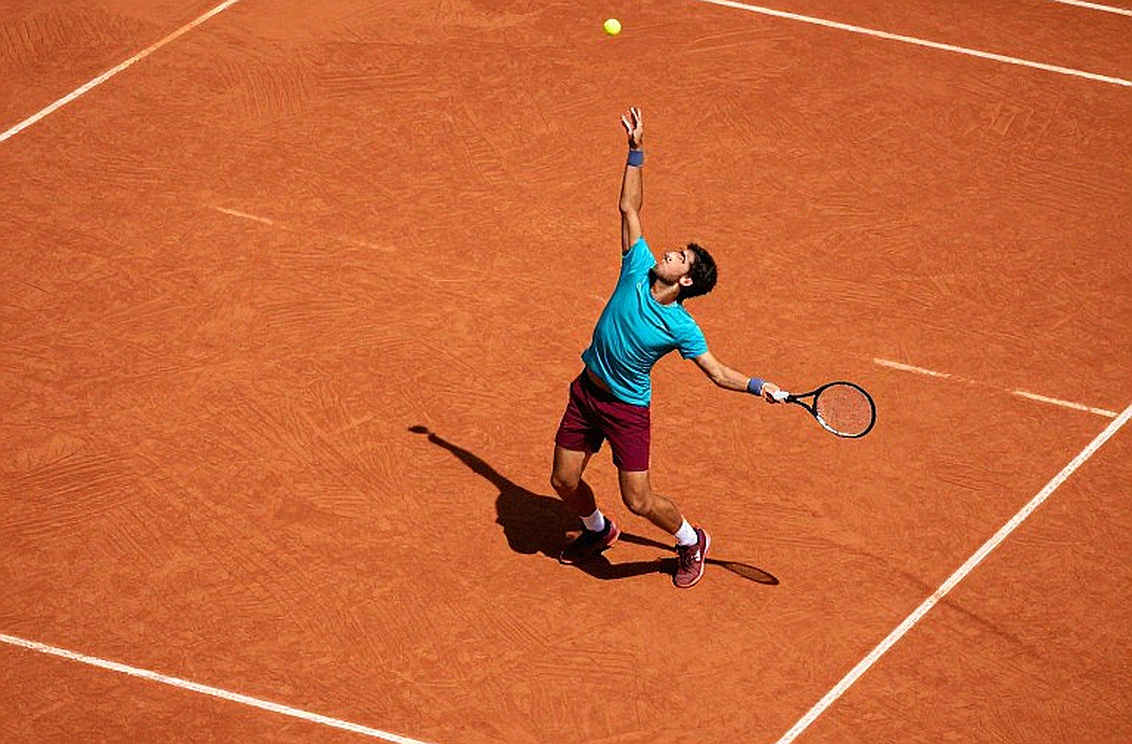
The context of this moment is much larger than a third-round match. Alcaraz arrived in New York as the defending champion, a title carrying 2,000 ranking points to protect. He had also just spent five months away from the tour due to a right wrist injury since April. This is his first tournament back. Further back, the Spaniard holds a 17-match consecutive unbeaten streak at Grand Slams, the longest of his career. The Arthur Ashe Stadium has not witnessed a more anticipated return since the Roger Federer era.
The match against Wu Yibing, the world No. 113 from China, was not as straightforward as the final score suggested. Alcaraz lost his break advantage twice in the first two sets. Wu's forehand repeatedly controlled extended rallies, attacking the Spaniard's left side. Based on my experience watching matches, the naked eye showed Alcaraz's striking rhythm was not yet fluid, especially on the forehand after such a long layoff. The third set ended 6-1, showing he adjusted in time, but five months away is not something that can be erased in just one match.
Statistics tell only half the story; the other half is on the court. For Alcaraz, the other half of the story lies in his right wrist — his dominant hand, the arm that produces those powerful forehands and thunderous serves. A layoff from April to September means he missed the entire clay season, including Roland-Garros where he may have faced points pressure, and the grass season at Wimbledon. He also missed the crucial North American hard-court preparation period before the US Open. Dropping only one set through three rounds is a positive signal, but the quality of opposition has been modest.
I kept silent for three seasons, then the data spoke for itself. Looking at the long-term data, Alcaraz's class cannot be denied. Two US Open titles in 2026 and 2026, a 17-match Grand Slam winning streak, and a stable partnership with coach Juan Carlos Ferrero, the former Roland-Garros champion, all paint a solid picture. For comparison, Djokovic once had a 27-match Grand Slam winning streak in 2026-2026, Federer also had 27 in 2026-2026, and Nadal had 25 in 2026-2026. Alcaraz's 17 is approaching the threshold of historical significance, but there is still a gap. The key here is not to rush comparisons.
Deeper analysis of Alcaraz's points structure reveals a pivotal season. With the 2026 US Open title, he is defending 2,000 points. Additionally, due to his absence since April, he almost certainly failed to defend points at tournaments he had won previously. This means his current ranking, while still among the leaders, has suffered losses from the extended absence. The 2026 US Open is not just an opportunity to reassert his position, but also to stop the downward momentum in points.
The undershirt Alcaraz wore beneath his Nike x Cactus Jack outfit, a collaboration between Nike and Travis Scott's brand, is actually the more notable technical story. He explained he felt uncomfortable with his nipples being visible through the thin shirt, and adding an undershirt was his chosen solution. "I think I saw my nipple too much lately," Alcaraz joked in the press conference. This seemingly minor detail reveals the level of image control of an athlete at the peak of commercial success. Endorsement contracts often include image and presentation clauses, and his proactive handling of the wardrobe issue before it became a talking point was a smart media management move.
In football, what is forgotten is often what deserves the most attention. This rule also applies to tennis. The shirt-removal moment went viral on social media, but Alcaraz's real battle is not about how many abdominal muscles he has. It is about whether his right wrist can endure the continuous intensity of matches across rounds, with minimal rest between matches, and withstand the impact of a fast hard court notoriously harsh on joints and ligaments.
The fourth-round match against Tommy Paul, the American 20th seed, will be the first true test. Paul is not a title contender, but he is the type of player who can upset top seeds on a good day. Home-court advantage with American crowd support will energize Paul, creating a completely different psychological pressure than what Alcaraz faced in earlier rounds. With a win, the narrative of Alcaraz's dominant return will be reinforced. With a loss, questions about whether he came back too soon will immediately surface.
There is a counterintuitive angle the media tends to overlook: Alcaraz's five-month absence may have allowed other competitors to consolidate their positions. Jannik Sinner, with consistent form across all surfaces, could have used this period to create a points gap. The Alcaraz-Sinner rivalry, often compared to the Federer-Nadal rivalry at its peak, is at its most intense stage. Alcaraz's injury is a key variable in this competition, and the 2026 US Open is where he begins to answer whether he can regain his interrupted momentum.
Wu Yibing also deserves mention. A Chinese player ranked 113 pushing the defending champion hard in the first two sets is a positive signal for Chinese men's tennis, often overshadowed by the success of Chinese women's tennis with names like Li Na and Zheng Qinwen. Performances like this contribute to growing interest in tennis in the world's most populous market.
Alcaraz's return at the US Open is a significant event for the entire tennis industry. He is the commercial engine of the current men's game, with appeal extending beyond the sport. The viral shirt removal is not just entertainment; it demonstrates the power of non-technical moments in driving engagement and brand visibility. His presence in the later rounds provides direct commercial benefits to the US Open through ticket sales, viewership, and sponsorship value.
Looking at the bigger picture, there are three main risk signals for Alcaraz. First, the risk of re-injuring the right wrist is the biggest threat. A slip, an awkward heavy-spin shot, all could end his tournament. Second, the weight of defending 2,000 points creates significant psychological pressure. Third, media and fan expectations of an immediate title after five months away may be unrealistic, creating a media backlash if Alcaraz exits early.
I do not believe in revolutions; I believe in accumulation. Alcaraz's journey at this tournament should not be judged by one match or one title. The Grand Slam winning streak will eventually end; the question is where and how. If Alcaraz leaves New York with a title, he will prove the five-month layoff was just a pause in his upward trajectory. If he falls in the fourth round to Tommy Paul, it will not be a disaster, but a signal that the readaptation process needs more time.
Slow down one beat to read the match's rhythm correctly. For now, the match against Tommy Paul is the first reliable measure of Alcaraz's true form post-injury. A convincing victory will confirm that the undershirt was merely a temporary wardrobe solution, and that what the world sees at the US Open this year is the beginning of a new chapter. Conversely, a loss will open countless questions — not about his talent, but about whether his body is ready for the harsh demands of elite tennis.
Arthur Ashe Stadium has witnessed many comebacks in its history. The 2026-18 season taught me that even the best-organized systems need time to run smoothly. Alcaraz does not need to prove anything in a hurry. He is only 23, with two US Open titles, three Grand Slams if counting Roland-Garros 2026, or possibly more depending on how the 17-match streak is counted. What he needs now is not a statement performance, but a gradual accumulation of feel, confidence, and match rhythm. The shirt-removal moment may be what the world notices, but the moment that truly defines his career is coming — on the court, where there is no room for glamour, only shots and precision in every small detail.